
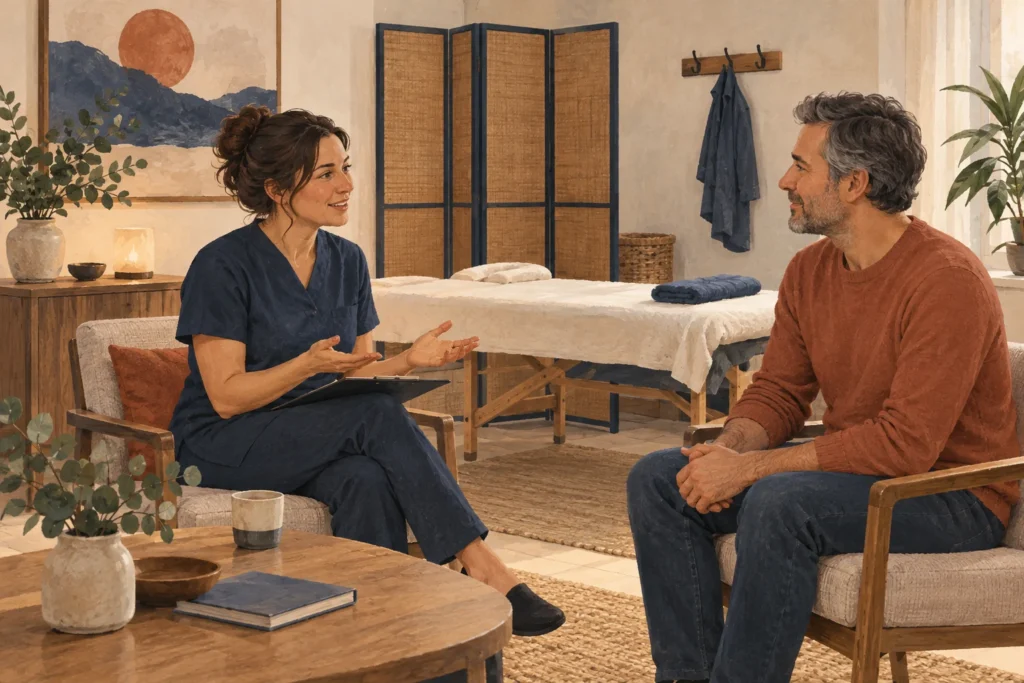
Booking your first massage can raise questions that a photograph of a beautiful room does not answer. What do you wear? Will you need to undress? Can you ask for quiet, a different position or a pause? You do not need to know massage terminology to prepare. A clear explanation before you pay, and a conversation before any contact begins, are more useful than trying to behave like an experienced client.
Find out what you are actually booking
Ask the provider to explain the service in ordinary language. A treatment name alone may not tell you which areas are included, whether clothing stays on, what products are used or how the appointment is organised. Confirm the total price, cancellation terms and whether the advertised duration includes the consultation, changing and payment as well as the massage itself.
If you have accessibility needs, ask about the entrance, toilet, treatment room and arrangements for getting comfortable before travelling. Describe the practical help you need rather than assuming it is available from a website photograph. A provider who cannot accommodate a particular requirement should explain that clearly, allowing you to choose another suitable option without an unnecessary journey.
Use the first conversation to agree on the plan
You can start with a simple purpose: “I am new to massage and want a comfortable introduction.” Explain preferences, areas you do not want included and any difficulty lying in one position. You can ask why a question is being asked, what information will be recorded and how it will be kept private. You do not need to discuss personal matters within earshot of other clients.
If you are uncertain whether massage is suitable because of a health condition, recent procedure or current symptoms, seek advice from an appropriate healthcare professional. Tell the practitioner about relevant guidance you have received. A first appointment is not a reason to ignore an existing care plan or to accept a medical explanation from someone whose training does not cover it.
Agree on clothing and coverage without embarrassment
There is no single clothing arrangement for every type of massage. Ask what the proposed service involves, whether a clothed alternative exists and how changing is handled. Agree on the areas involved before the practitioner starts. If you prefer not to remove an item, say so and discuss whether the service can be adapted or whether another option would suit you better.
The CNHC professional code provides a useful example of standards around dignity, explaining clothing changes and respecting personal sensitivities. Its rules apply to its registrants; it is not a universal description of every provider. What matters at your appointment is a clear agreement that you understand, rather than pressure to follow an unexplained routine.
For example, imagine someone feels uncomfortable changing while another person remains in the room. They can ask how privacy will be provided before agreeing to the session. Discussing this before changing gives both people time to agree on an arrangement, rather than waiting until the moment already feels awkward.
You can change your mind during the session
Agree on a straightforward way to communicate. “Please use less pressure”, “I would like to change position” and “please stop” do not need an elaborate explanation. You can be quiet without giving up the ability to speak. Equally, you do not have to make conversation to seem polite. Ask for the experience that was agreed and raise changes when you need them.
The practitioner may also suggest an adjustment or explain why a requested service is unsuitable. A professional exchange allows both people to discuss that openly. What should not happen is a new area or a different approach being introduced without a clear conversation. Paying for a session does not mean that every possible technique is automatically part of your agreement.
Leave room for questions at the end
Before leaving, ask about anything you did not understand, including the products used and the next step if an unexpected concern arises. Describe how the experience felt in your own words. You do not need to provide a positive review, accept a photograph or buy another appointment as part of finishing the service.
If a further visit is suggested, ask what its purpose would be and what it would cost. Take time to decide. A reasonable first experience can be valuable even when you choose not to repeat it. It can simply help you understand your preferences and the questions you would ask another provider.
Make your shortlist about communication as well as atmosphere
Explore what massage involves and compare the services listed in the Massage Alliance directory. Read each profile’s stated status, training and scope. An international association credential can make professional commitment more visible, while your own questions help establish whether this particular appointment suits you. Choose someone who makes room for those questions and gives you clear, unhurried answers.