

Studying anatomy for massage means connecting what you see in an atlas with body position, movement and respectful touch. Memorising names helps, but learning becomes useful when you can explain where you are working, which structures are in that region and which boundaries you must respect.
Palpatory anatomy develops the ability to orient yourself through touch. Learning it requires observation, supervised practice and correction. It also requires acknowledging uncertainty: feeling a firm or sensitive area does not, by itself, establish the cause of discomfort.
Start with the language of orientation
Before accumulating lists of muscles, review anatomical position and terms such as anterior, posterior, medial, lateral, proximal and distal. These provide stable references for describing the body even when someone is lying down or sitting. OpenStax explains this terminology and the anatomical planes in its anatomy and physiology textbook.
Try a simple exercise with a diagram: describe one structure’s position relative to two others. Then change the view and check whether your description remains correct. If you only recognise a muscle in a front view, study other perspectives before trying to locate it on a person.
Work on laterality too. “Right” and “left” should refer to the person being described. This habit prevents mistakes in notes, explanations and professional communication. Use understandable language with clients and reserve full terminology for study materials where needed.
Study each region as a whole
A muscle relates to tendons, vessels, nerves and connective tissues. The OpenStax chapter on skeletal muscle describes that organisation and the transmission of force to tendons. For massage learning, this encourages studying what surrounds a muscle and how its position changes during movement.
Prepare a short study sheet for each region. Include bony landmarks, main muscles, associated movements, structures needing particular caution and questions you cannot yet answer. Compare it with an atlas and review it with a teacher. Avoid turning it into a collection of claims about injuries you cannot verify.
| Study region | Learning objective | How to check it |
|---|---|---|
| Shoulder and shoulder girdle | Connect the scapula, humerus and arm movements. | Explain on a model which structures change position. |
| Arm and forearm | Distinguish muscle groups and their main actions. | Relate a comfortable voluntary movement to the anatomical diagram. |
| Back | Distinguish superficial and deep layers. | Describe what you identify and what touch cannot establish with certainty. |
| Thigh and lower leg | Organise compartments and anatomical landmarks. | Identify them in an atlas first and justify the location with the teacher. |
The table proposes study objectives; it is not a treatment sequence. Add other regions when your training and supervision allow you to approach them safely.
One specific example is the biceps brachii. It contributes to elbow flexion and forearm supination, the rotation that brings the palm forwards in anatomical position. The brachialis, located deeper, also contributes to flexion. This relationship, described in OpenStax, teaches something useful: movement may involve several muscles. Observing it does not justify attributing the entire action, or possible discomfort, to a single structure.
Moving from the atlas to the body requires supervised practice
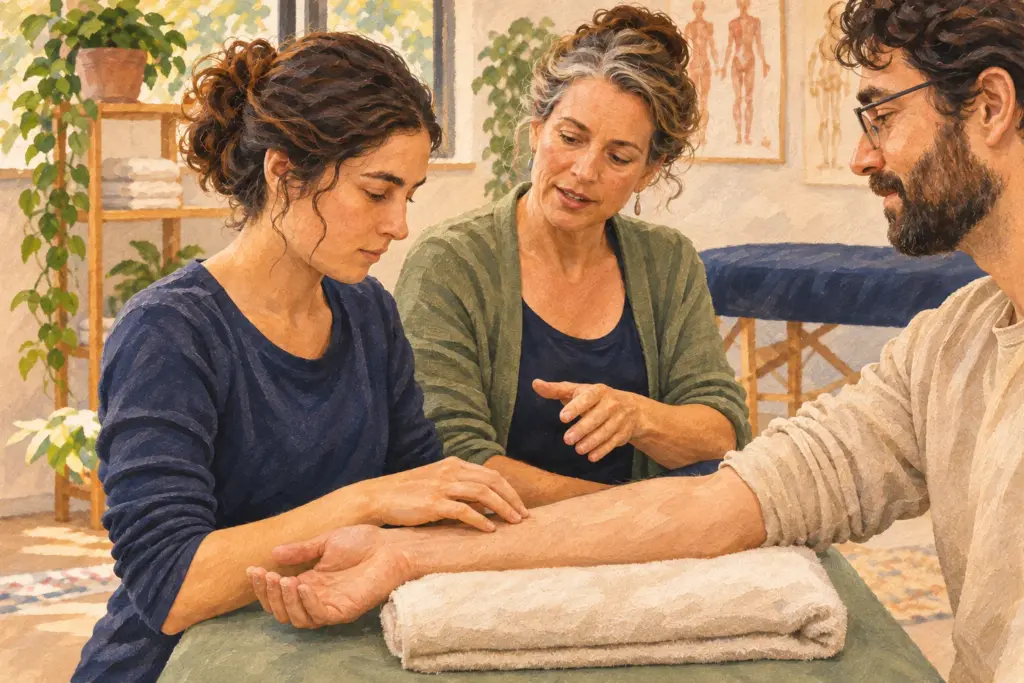
Begin with accessible landmarks and exercises appropriate to the learner’s level. Explain what you will observe, what contact you propose and how it can be stopped. Practice partners should be able to accept or decline each part without feeling obliged to demonstrate tolerance.
The minimum pressure needed to orient yourself is usually a better starting point than trying to reach deep structures. If you cannot locate what you expected, return to the diagram, review the position and ask the teacher. Increasing force does not resolve anatomical uncertainty. Nor does it turn a tactile impression into confirmed identification.
In an introductory exercise on the arm, for example, the goal may be to observe changes in contour during a comfortable active movement and connect them to the atlas. The task ends when you can describe what you observed. There is no need to provoke pain, search for tender points or interpret movement as a test for injury.
Practising with different people helps you recognise variations in size, proportions and superficial tissue. Always do so with consent and within the planned exercise. Anatomy drawings are learning references; people do not have to reproduce their exact appearance.
Add physiology to the anatomical map
Anatomy describes structures; physiology asks how they function. For a useful study session, connect one anatomical region with a basic question about movement, sensation or circulation. Then separate what your course explains from what you can actually observe in a wellbeing appointment. A person’s feeling of tension does not tell you which biological mechanism is responsible.
Use three columns in your notes: what I can describe, what I do not yet understand and who can help me check it. For example, you can describe an agreed movement and the person’s feedback without claiming to have measured nerve function or circulation. Bring uncertainties to a qualified teacher instead of filling the gap with a persuasive explanation.
Match study evidence to the credential you are seeking
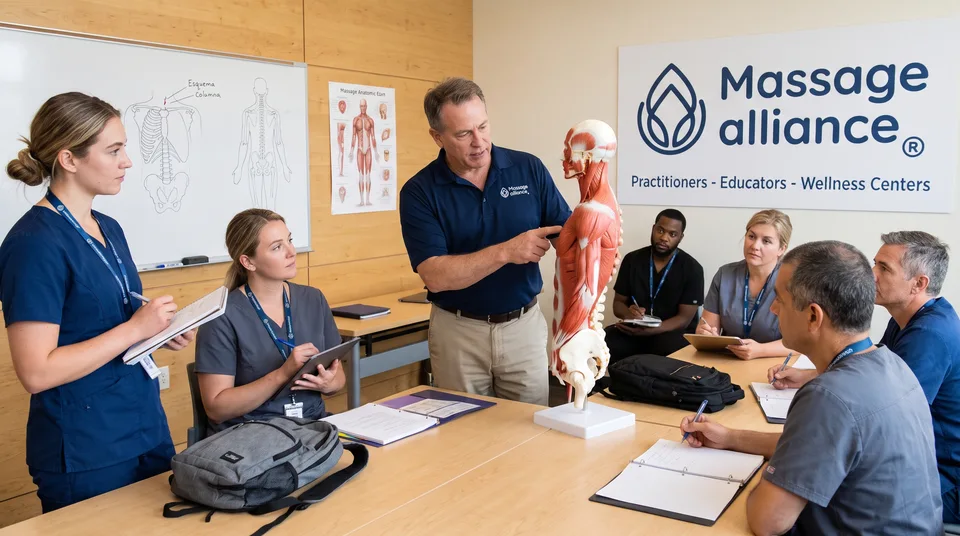
The published Massage Alliance assessment requirements distinguish pathways. CMP 200 uses documentary review without an examination; CMP 500 adds a knowledge examination. E-CMP 200 and E-CMP 500 include anatomy and practical video assessment. Mastery is a separate teaching credential with its own qualification pathways and teaching review; E-CMP 500 is not a prerequisite.
Keep your diploma, syllabus, completed practical hours and assessment results organised. These are different kinds of evidence, not interchangeable totals. Preparing for an examination does not replace supervised practical learning, and a private credential does not expand the activities you may legally perform.
What palpation lets you observe and what it does not confirm
You can describe the location of contact, the person’s response and the change you notice when a position changes. Claiming a specific abnormality requires a different level of evidence. Avoid statements such as “you have a vertebra out of place” or “this knot causes everything” when based only on your hands.
A study of lumbopelvic palpation accuracy involving 83 participants and CT verification found results that varied by structure and errors in localisation. The study concerns those tasks and that region; it does not show that all manual contact is useless. It does help explain why some tactile findings should be interpreted with limited certainty.
Separate observation from interpretation in your notes. “The person reports sensitivity to contact in this area” describes what happened. “An adhesion explains their pain” introduces a cause you may not have established. This distinction improves learning and supports honest communication with other professionals.
In a wellbeing service, anatomical knowledge should help you recognise your boundaries and adjust contact. When a situation needs healthcare assessment, direct the person towards that care rather than trying to resolve uncertainty through an examination outside your competence.
A study plan combining understanding and practice
You can organise a four-week study cycle, adapted to the programme you are taking. It is neither an official allocation of training hours nor proof of competence.
- First week. Review terminology and general landmarks. Draw a map of one region and explain its relationships without consulting notes.
- Second week. Add movements and related structures. Alternate atlas views and use a three-dimensional model if available.
- Third week. Practise the authorised exercises under supervision. Note where you make mistakes and the corrections received.
- Fourth week. Repeat the tasks with another position or example. Check whether you can explain the location, boundaries and purpose of contact.
Reserve a few minutes to recall what you have learned without consulting materials. If you cannot explain a concept simply, return to its foundations before adding more names. A corrected, reused diagram contributes more to tracking learning than a folder of images you never review.
Technology can make it easier to change perspective and visualise layers. Use it alongside an atlas and practical teaching. A three-dimensional image alone cannot assess your touch, pressure or communication.
How to know whether learning is becoming established
Ask to be assessed through observable tasks: locating a region, describing an anatomical relationship, explaining a movement, making the agreed contact and recognising when you cannot identify a structure confidently. Feedback should include what you do well and what needs practice.
An examination of names can test one part of knowledge. Practical assessment adds information about its application. Keep the syllabus, documented hours and assessment details of your training, because each explains a different part of your professional development.
If you are comparing courses, Massage Alliance’s guide to online and in-person training will help you ask who will observe your practice and how you will receive corrections. To learn how documentation is reviewed and which assessments apply to each pathway, consult Massage Alliance’s verification and assessment criteria.
Frequently asked questions about anatomy and massage
Must I memorise every muscle before practising?
You need a sufficient foundation for exercises at your level. Organise learning by region and expand it under your teacher’s supervision. A complete memorised list does not, by itself, demonstrate that you can apply the knowledge safely.
What should I do when I cannot recognise a structure by touch?
Stop searching, review the position and return to atlas landmarks with your teacher. Do not try to resolve uncertainty by increasing pressure. Identifying what you cannot establish confidently is an assessable part of learning.
Does an area that feels hard confirm a muscle contracture?
An isolated sensation does not confirm a cause or diagnosis. Describe observations cautiously and work within your training. If symptoms need assessment, direct the person to the appropriate healthcare professional.
Make your knowledge understandable in another language
Preparing for training or employment in another country reveals an important distinction: recognising a structure is not the same as being able to explain what you are doing. Build your own glossary of anatomical terms, movements and simple expressions you would use with a client. Keep study terminology separate from the words needed to ask permission or understand discomfort.
Connect each unit of your training to its content, hours and assessment. For example, New York’s education requirements include anatomy, physiology and other specified subjects; having studied them does not, by itself, establish that the receiving authority considers your programme equivalent. Total hours alone do not explain how learning was distributed either.
A useful file can include the original syllabus, a translation when requested and assessment examples without clients’ personal data. Ask the school to distinguish theory, supervised practice and independent work, rather than reconstructing those figures from memory.
When practising in another language, rehearse a short explanation before each manoeuvre and check that the other person can express their limits. Fluency in technical vocabulary needs to be accompanied by understanding, supervision and caution; it does not expand your professional scope or turn palpation into diagnosis.
Connect study, practice and recognition
Connect what you study with practice and a clear way to demonstrate your preparation. Discover Massage Alliance’s international community and its public recognition criteria. You can ask which pathways fit your documented training and which continuing learning options are available. Tell us your goals and enquire about requirements and conditions as you take your next step. I would like information about joining.
Sources and further reading
- OpenStax — Anatomical terminology.
- OpenStax — Organisation of skeletal muscle.
- OpenStax — Muscles of the shoulder girdle and upper limb.
- Primary study — Sensitivity for palpating lumbopelvic soft-tissues and bony landmarks and its associated factors, 2017.
- NYSED — Massage Therapy: License Requirements