
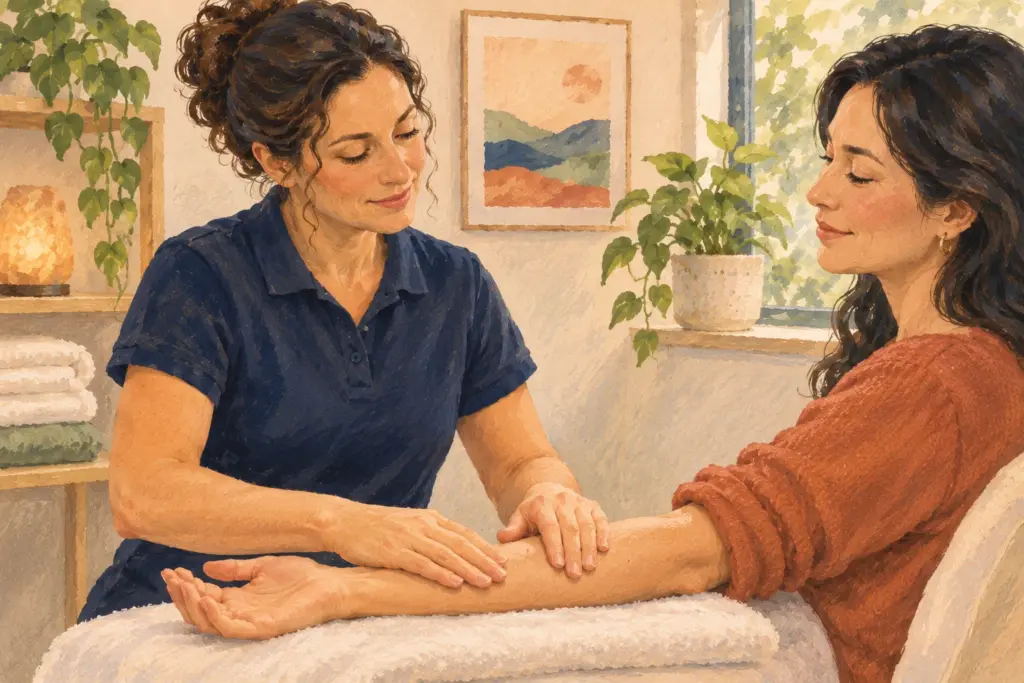
Manual lymphatic drainage requires understanding why it is proposed, whom it is intended for and what preparation the practitioner needs. The term appears in aesthetic services, training programmes and healthcare, but those settings have different objectives and responsibilities.
For a massage practitioner, the first step is to define the intended service and check that their training enables them to provide it. Learning a sequence of movements may be part of the process; recognising boundaries, explaining expectations and deciding when a request needs specialist assessment are also essential. This guide focuses on professional judgement and does not describe techniques for treating lymphoedema.
What manual drainage is and why context matters
The International Society of Lymphology’s 2023 consensus describes manual lymphatic drainage as a specific, light manual technique within decongestive management. It also distinguishes lymphoedema from other causes of swelling. Seeing an enlarged area is therefore not enough to decide which intervention is needed.
In Spain, qualification IMP248_3, updated by Order PRE/2054/2015 includes lymphatic drainage for aesthetic purposes. That designation identifies a specific field; it does not turn aesthetic training into authorisation to practise a healthcare profession.
Specify the context when presenting services. “Aesthetic drainage” and “lymphoedema treatment” should not be used interchangeably. The person booking needs to understand what you offer and who can assess a health problem when necessary.
The same clarity should apply between professionals. If you work with a centre or receive a referral, agree your role, the relevant information and who is responsible for healthcare decisions.
What the evidence allows us to say about lymphoedema
The NHS places manual drainage within a decongestive programme that includes compression, skin care and exercise. It describes specialist work to control symptoms and maintain results, without presenting it as a cure. This helps explain why the effects of an entire care programme should not be attributed to an isolated session.
One relevant example is the multicentre EFforT-BCRL trial, published in 2022, involving 194 participants with chronic unilateral breast cancer-related lymphoedema. All received components of decongestive therapy. Adding traditional or fluoroscopy-guided manual drainage provided no clinically important additional benefit compared with placebo drainage in that population.
The result needs precise interpretation. It does not show that every person with any type of oedema responds in the same way. It does prevent using that study to promise that manual drainage always adds benefit to the complete treatment.
The international consensus acknowledges limitations in the evidence and distinguishes outcomes by context. When assessing a claim, ask who was studied, what the comparison was, for how long and what was measured. Improved comfort, a change in volume measurement and a change in disease progression are different outcomes.

What to clarify before accepting a session
The initial conversation should identify the real reason for the request. “I want drainage” may mean someone wants an aesthetic service, is following their healthcare team’s advice or is trying to address swelling that has not been assessed. The three situations should not receive the same routine response.
| What the person describes | What to clarify | Approach |
|---|---|---|
| They request an aesthetic service | Specific purpose and expectations | Define a service consistent with your training and boundaries |
| They have diagnosed lymphoedema | Care plan and responsible professionals | Refer to the specialist healthcare team; intervene only with the necessary healthcare qualifications and training, within that plan |
| They have new or unassessed swelling | When it started and whether it has been assessed | Do not assume drainage is needed; recommend healthcare assessment |
| They seek care after an operation | Instructions, restrictions and the team’s follow-up | Do not apply a universal timetable based on the name of the surgery |
In some situations the priority is clear: the NHS warns that recent pain and swelling in one leg may require urgent assessment. Do not try to resolve them through drainage before the cause is known.
If you do not have the preparation needed for the case, explain this plainly. Knowing when to recommend the appropriate resource is part of professional care.
How to choose training in manual lymphatic drainage
Request the full syllabus and read it with real working situations in mind. What will you learn to observe, explain, perform and decide by the end? A list of body regions does not, by itself, show how judgement for working with a person will be taught.
Check that the training connects lymphatic anatomy and physiology with the technique’s aims. It should be possible to distinguish established knowledge, proposed hypotheses and questions needing better evidence. Also ask which learner profiles it accepts and what prior knowledge it assumes.
For practical work, ask specifically about supervision, correction and assessment. Will a teacher observe your performance? How will your ability to justify a decision be assessed? What happens if you need more practice? These questions help evaluate the learning process without reducing it to advertised hours.
Training should clearly identify its field—aesthetic, wellbeing or healthcare, as applicable—and the professional responsibilities it assumes. Be wary of explanations giving a diploma a broader scope than the programme actually completed.
Ask for an example teaching case: someone requests drainage after a procedure and provides incomplete instructions. Sound learning should address what to ask and when to postpone, as well as teaching manual movements.
How to discuss results without overpromising
Start by agreeing a goal you can explain and review. If the service is aesthetic, describe it accordingly. When lymphoedema care is involved, goals and follow-up should fit the specialist plan.
Avoid turning every observed change into an extravagant physiological explanation. A photograph, a feeling of lightness or a change in circumference does not, by itself, prove fat loss, toxin elimination or resolution of a lymphatic disorder. Before using an outcome in advertising, ask what it actually shows and which interpretations it could encourage.
To record an experience usefully, distinguish the initial objective, what was done and what the person reports afterwards. Where measurements are part of a competent assessment, they should be taken comparably; changing the procedure can make interpretation difficult.
Do not promise a fixed number of sessions for everyone either. Explain when progress will be reviewed and what might require a change of approach. That discussion makes decisions understandable and avoids continuing a service solely because it was included in a package.
Add the technique to a coherent professional offering
Before adding manual lymphatic drainage to your service menu, review three documents: the programme you completed, the service description and the information provided to people booking. They should tell the same story about your competencies, aims and boundaries.
It helps to write a short internal acceptance guide: which requests fit, which need more information and which should be directed to another professional. Share it with whoever manages appointments so communication is consistent from the first contact.
If you need to strengthen your preparation, consult Massage Alliance’s continuing education information and centres’ specific programmes. Ask about supervised practice, assessment and the certificate’s scope. Introducing a technique responsibly means being able to explain both its purpose and the conditions needed to offer it.
Before offering drainage in another country, define the precise scope
The term “lymphatic drainage” can appear on spa menus, aesthetic programmes and healthcare services. When relocating, describe the service by its purpose, intended population and necessary preparation, rather than assuming that the same name permits the same activity in every territory.
In Spain, Annex II of Order PRE/2054/2015 includes drainage for aesthetic purposes within IMP248_3. The order itself states that these qualifications do not regulate professional practice. This example helps distinguish educational content from authorisation; it does not establish equivalence with a healthcare profession abroad.
Before choosing an international course, request its objectives, intended participants, entry requirements, supervised practice and limits in writing. Ask the competent authority where you intend to work what recognition it has, if any, and what activities your underlying qualification permits. A diploma in a technique does not answer those questions by itself.
Where diagnosed lymphoedema or postsurgical follow-up is involved, maintain coordination with the relevant healthcare team and comply with local professional requirements. An international recommendation on lymphoedema care contributes clinical knowledge; it does not grant a licence or justify offering treatments beyond your competence. Explain this distinction in your advertising and when responding to enquiries too.
Look for training that also explains its limits
Choosing a technique also means choosing how to learn it and demonstrate your preparation. Get to know Massage Alliance’s public recognition criteria, its international outlook and its continuing education options. Explain your experience and learning purpose; you can ask about requirements, membership conditions and available pathways before deciding. I would like information about joining.
Sources and further reading
- International Society of Lymphology: 2023 consensus on peripheral lymphoedema.
- NHS: lymphoedema treatment.
- De Vrieze and colleagues: EFforT-BCRL trial, Journal of Physiotherapy, 2022.
- BOE: Order PRE/2054/2015, Annex II, Aesthetic Massage and Associated Sensory Techniques, IMP248_3.
- NHS: deep vein thrombosis.