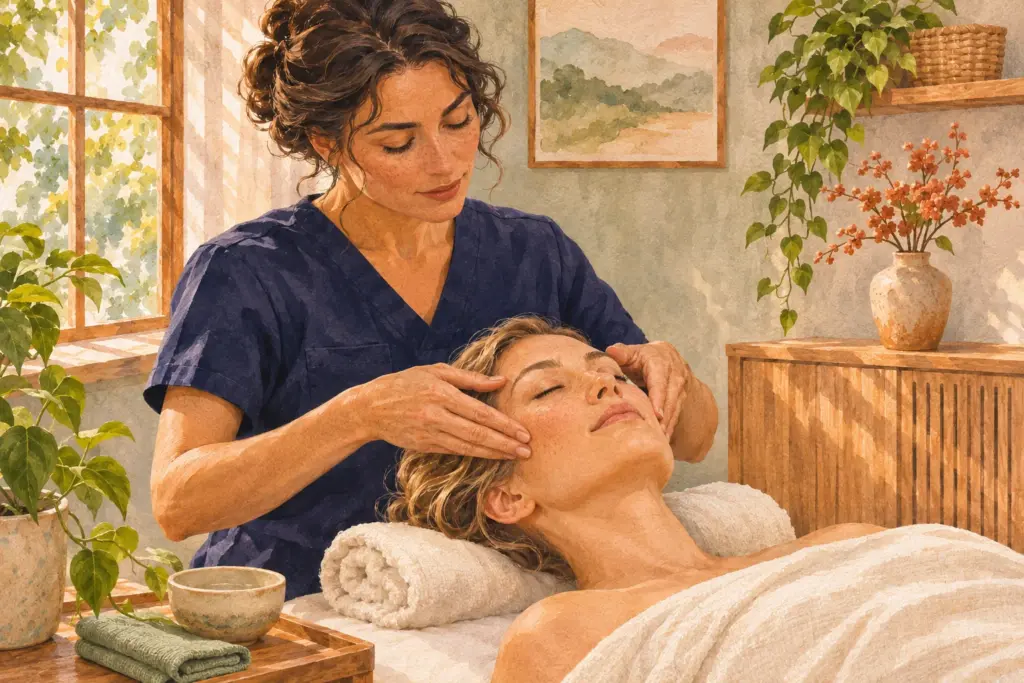

Choosing a Thai massage is easier when you know what the appointment will involve. The name can bring to mind stretching, work on a floor mat and a style of contact that feels different from a familiar table massage. Before booking, turn that impression into practical questions about clothing, position, pressure and the movements you are comfortable receiving.
The most useful description comes from the person offering the session. It should make room for your preferences and circumstances, without suggesting that a traditional sequence must be completed at any cost. You are booking an experience with an explained scope, rather than agreeing to an unknown test of flexibility.
What makes a Thai massage session distinctive
Traditional Thai massage combines pressure with movement and stretching, adapted to the person receiving it. Some movements involve the practitioner supporting or guiding a body part while the recipient remains relatively passive. The precise combination and format should be explained before you agree to it.
That description is more helpful than labels such as intense, authentic or complete. Ask what those words mean in the actual service. Will most of the appointment involve pressure, changes of position or assisted movement? You do not need to learn technical terminology to ask for a clear account.
Nor does tradition require one fixed experience for everyone. A session can be discussed in terms of its purpose and the person’s comfort. If something important to you is absent from the explanation, ask before confirming the booking.

Ask about clothing, the mat and getting comfortable
Check whether you will remain clothed and whether the session takes place on a floor mat or treatment table. If a clothed session is offered, ask what clothing allows comfortable movement and whether you need to bring a change. Confirming this beforehand avoids uncertainty when you arrive.
A floor-based arrangement also raises practical questions. Explain if getting down to the mat, turning or standing up is difficult. Ask about supports and whether an accessible alternative is available. A spacious photograph cannot tell you how the practitioner will accommodate your needs.
There should also be a clear explanation of preparation and privacy. Our guide to clothing, privacy and a first massage appointment can help you decide which questions matter to you. You can ask them even if you have received massage many times before.
Agree on movement and pressure
Tell the practitioner which areas and positions you are comfortable with, and what you would prefer to leave out. Ask them to explain an unfamiliar movement before starting it. Agree on a simple way to pause or change the work without needing to justify your preference.
The Ontario massage regulator’s consent standard provides a useful professional reference: consent concerns the proposed work and continues throughout it. This is an example from one jurisdiction, rather than a statement of worldwide legal rules.
In practical terms, a booking does not oblige you to endure painful pressure or an uncomfortable stretch. You can change your mind about a position, ask for less intensity or stop. The conversation should continue as the session develops, particularly when the practitioner introduces a different kind of contact.
What UNESCO recognition means
Nuad Thai was added to UNESCO’s Representative List of the Intangible Cultural Heritage of Humanity in 2019, as recorded in the Thai government’s announcement. That recognition concerns cultural heritage.
It does not certify the individual practitioner you are considering, approve a particular business or demonstrate a medical result. A heritage reference should help explain a tradition’s significance; it should not replace information about the person delivering the appointment.
You can respect a practice’s cultural setting while asking ordinary questions about training, boundaries and suitability. There is no conflict between taking the tradition seriously and expecting a careful, understandable service.
What clinical research can tell you
A Spanish public health technology assessment, published in 2020, found that the clinical studies it evaluated did not allow firm conclusions about efficacy and safety for the selected conditions. Its literature search ended in 2019, so it should not be presented as an exhaustive account of every later study.
The useful distinction is between choosing an experience for comfort and expecting it to treat a health problem. Enjoying an appointment does not establish a disease-treatment effect. Equally, limited clinical evidence does not tell you whether you will personally enjoy the format.
Traditional explanations of energy can be presented as part of a cultural account. They should not be converted into claims about proven biological mechanisms, removal of toxins or correction of an illness. Ask what the practitioner means in concrete terms.
When to adapt or postpone the appointment
Share relevant changes in your health, recent procedures, injuries or restrictions before the session starts. Explain any movement that worries you. This gives the practitioner a chance to consider whether the offered service can be adapted within their actual preparation, or whether more information is needed.
New, severe or unexplained symptoms deserve appropriate healthcare attention rather than an assumption that stretching will sort them out. The NCCIH massage overview describes risks and evidence limitations and encourages informed discussion with healthcare providers.
Our guide to adapting or postponing massage explains the broader decision. A tradition’s name cannot make an unsuitable movement appropriate. Where a healthcare team is managing a condition, discuss the proposed activity and relevant restrictions with that team.
Choose someone who explains their work
Look beyond the style name and ask about the appointment you will actually receive. These questions help compare services:
- What training and practical experience support the Thai massage being offered?
- What format, clothing and equipment should I expect?
- How are pressure, positions and movements adapted to my preferences?
- How will you explain unfamiliar contact and respond if I ask to pause?
- What would lead you to adapt, postpone or recommend another kind of assessment?
The guide to checking a massage professional’s credentials helps distinguish training information from broad recognition claims. You can also use the Massage Alliance professional directory to explore profiles. Confirm the particular service directly: a profile or credential does not describe every session a person offers.
Questions people often ask
Do I need to be flexible already?
Explain which positions and movements are comfortable for you. Ask whether the practitioner can offer an appropriate session with those preferences. You should not force a joint or accept discomfort to fit an advertised sequence.
Will I remain fully clothed?
Confirm this for the actual booking. Ask what to wear, how preparation works and whether products will be used. Clear advance information is more useful than assuming every service with the same name follows one format.
Does a stronger stretch mean a better session?
No. The session should fit the agreed purpose and your response. Increasing intensity to prove endurance does not establish quality or benefit. Explain discomfort promptly and expect the practitioner to take your request seriously.