
Opening your own massage practice involves more than finding an attractive room and buying a table. You need a service you can explain, premises that suit it, enough time to deliver it and a way to handle bookings and personal information responsibly. A useful opening plan turns those decisions into checks you can complete before spending heavily.
This guide is an organisational framework, not a universal licence checklist. Requirements depend on the location, the activity and the professional title you intend to use. Confirm them with the relevant authorities and advisers before signing a lease or announcing an opening date.
1. Define the service before choosing the premises
Write a one-page description: who the service is for, its purpose, the methods within your training, session length and how clients will book. State whether you will work alone, share premises or offer visits elsewhere. Distinguish the time with the client from the total appointment slot.
Explain the limits of your service and how you will respond when a request falls outside your competence. A wellbeing room and a regulated healthcare activity can have different requirements. Our guide to training and professional requirements helps frame the questions; a translated course title or private credential does not settle them.
2. Check the activity and premises before committing
Ask the local authority whether the intended activity is permitted at the address and what approvals, notifications or inspections apply. Check access, occupancy, fire arrangements, ventilation, toilet facilities, signage and any proposed building work with the appropriate specialists. An attractive listing or a landlord’s informal assurance is not the same as confirmation.
In the EU, Your Europe explains registration, permits and licences and points to national contacts. Elsewhere, find the equivalent business and local authorities. Keep a record of who answered, what activity was described and what remains pending. Clarify lease conditions and professional insurance before taking on a financial commitment.
3. Calculate capacity using the whole working day
List one-off costs such as the deposit, necessary works and equipment, then recurring costs such as rent, utilities, laundry, insurance, software and professional advice. Add your working time and a reserve for foreseeable replacements. Use your own quotations; another practice’s turnover is not a reliable budget.
Available appointment time equals working time minus preparation, cleaning, administration and breaks. As a fictional planning example, six available hours minus 90 minutes of other duties leave 270 minutes: that accommodates four 60-minute sessions with 30 minutes unallocated, not six sessions. Capacity is not demand. Review prices with our rate-calculation guide and compare insurance using the policy checklist.
4. Plan the visit through the room
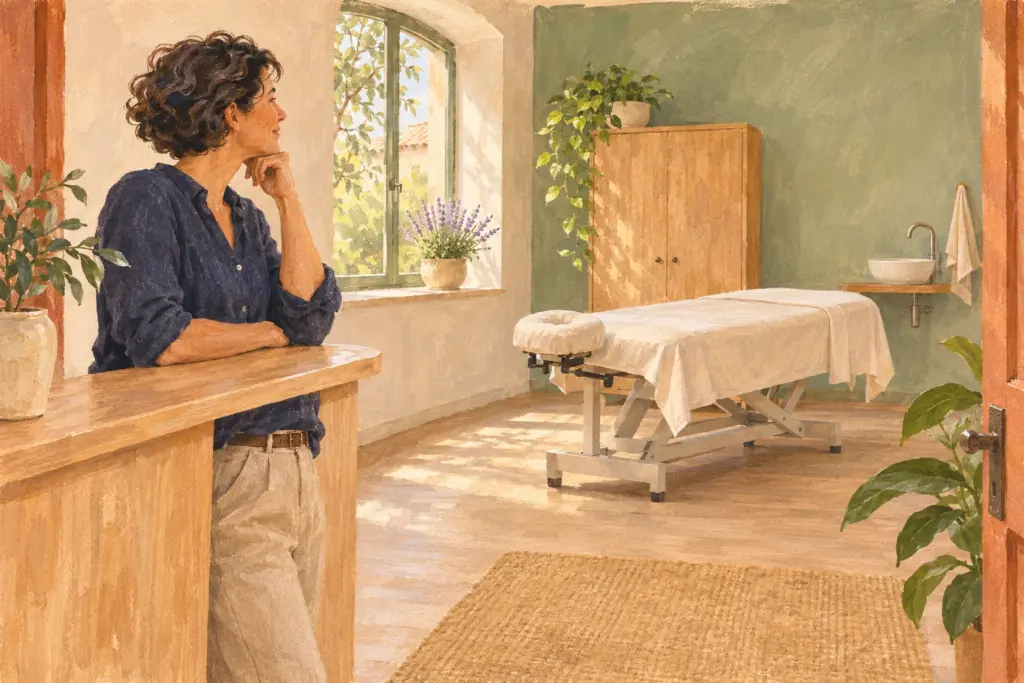
Walk the route from arrival to departure. Consider how someone finds the entrance, waits, discusses preferences, changes in privacy and leaves. Check accessibility for the people you expect to welcome and confirm any applicable requirements. Explain real access limitations before booking so a client can make an informed choice.
Position the table, stool, storage and lighting so you can move and reach supplies comfortably. Choose equipment suitable for its intended use and follow its operating limits. The EU-OSHA overview of musculoskeletal risks highlights both physical and organisational factors: an adjustable table cannot compensate for a timetable with no room to reset or rest.

5. Make cleaning and preparation repeatable
Write a between-client routine covering hand hygiene, contact surfaces, clean linen, used linen, waste and replenishment. Match products and procedures to the equipment instructions and applicable local requirements. Do not assume one laundry temperature or cleaning product suits every fabric and surface. Store clean and used materials separately.
Time the routine in the actual room. If the appointment schedule cannot accommodate it, change the schedule. Check ventilation, supplies and the condition of the table as part of opening and closing. Our massage-room hygiene guide provides a structure for a practical procedure; adapt it to your premises rather than copying it without review.
6. Prepare clear booking and session information
Before someone commits, make the service, price, duration, location and cancellation conditions easy to find. Explain what the first visit involves and give a contact for access questions. Check how payments, refunds and late arrivals will be handled under the rules applying to your business. Avoid presenting a rigid course of sessions as necessary for every client.
Prepare a conversation about preferences, boundaries and consent, and a way to stop or adapt the session. Decide how to respond to a concern or incident and when to recommend appropriate healthcare assessment. Confirm emergency arrangements for the premises; a massage booking should never delay urgent help.
7. Collect information for a stated purpose
Start with what you genuinely need to arrange and provide the service. Decide who can access records, how they are protected, how long they are kept and how clients can exercise their applicable rights. Check the booking provider’s role and data arrangements before uploading records. Avoid putting sensitive client details in a shared calendar.
The EU data-protection guide explains key GDPR duties where that law applies. Health information needs particular care. A booking does not automatically authorise promotional messages or public photographs. Our client-form guide helps separate useful questions from unnecessary collection. Seek advice on your actual systems and jurisdiction.
8. Show verifiable preparation
Describe your training accurately and keep evidence available. Use a quality seal only if it has been awarded to you and remains valid for the relevant category; link to its verification where available. Explain the issuer and scope rather than suggesting government approval. Massage Alliance’s certification information distinguishes its private recognition framework.
Membership, certification, local permission to operate and insurance are separate matters. None guarantees a full diary or a particular client outcome. For your own business profile, use truthful photographs of the real space and clear contact information. Illustrative images should be identified as such.
9. Rehearse the first visit before opening
Run a practice booking with a colleague using invented details. Follow confirmation, arrival, conversation, room preparation, payment and departure. Check the mobile booking journey and record delays or unclear instructions. Do not create a false customer review or retain unnecessary test data.
- Activity and premises checks: confirmed or clearly pending, with a responsible person.
- Budget and capacity: based on quotations and time measured in the room.
- Client information, privacy and cleaning: understandable and workable.
- Outstanding problems: resolved before they affect a real visit.
Choose an opening date when the required checks and practical arrangements are ready. Review the first weeks using real questions, manageable workload and actual costs. Adjust one concrete issue at a time instead of expanding a process that is not yet working reliably.